
Meal Prep Breakfast for the Week So It Still Tastes Good by Friday
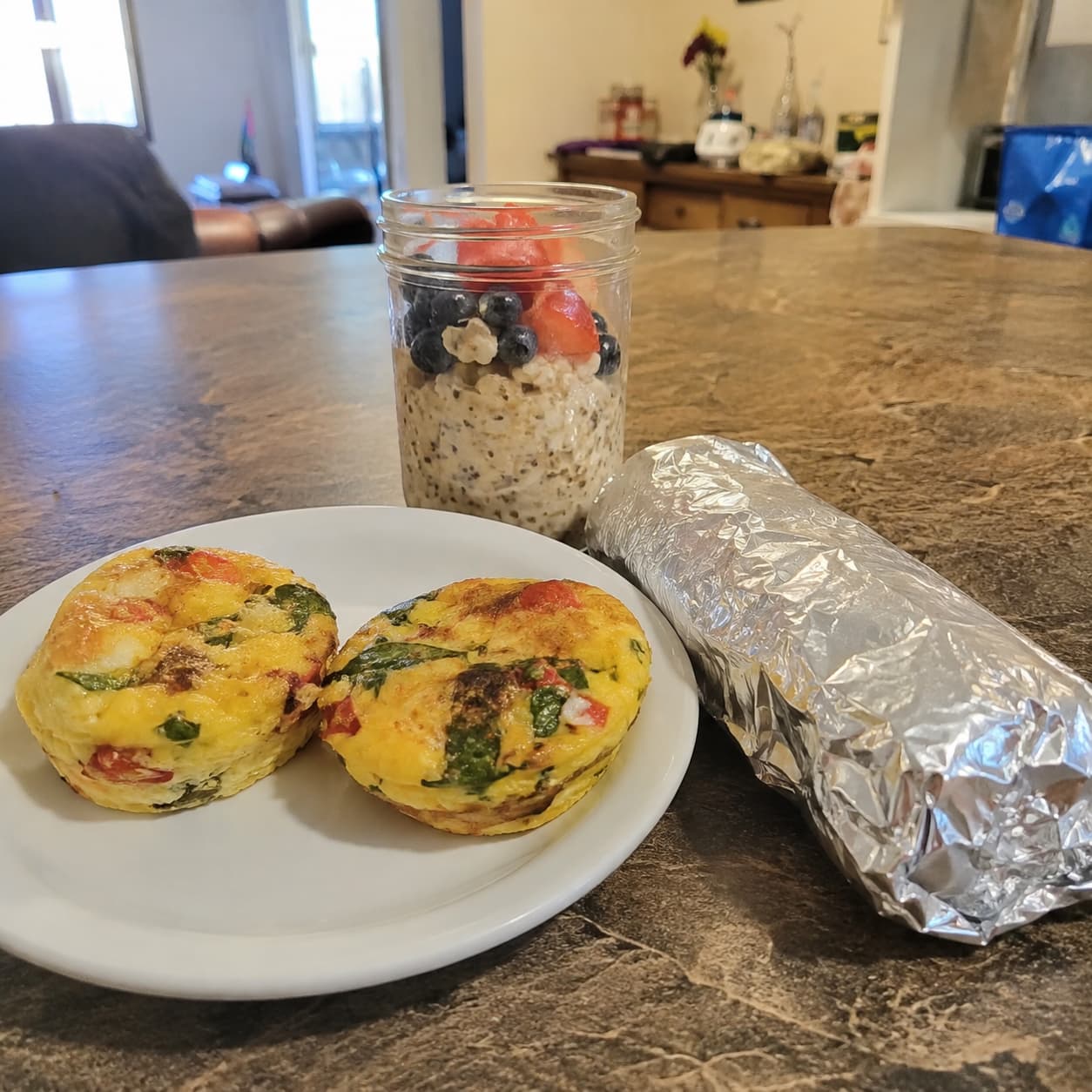
Most breakfast meal prep fails for the same reason: it’s built like dinner meal prep. One dish, cooked Sunday, split into five identical containers. That works for a pan of chicken thighs, since dinner is eaten slowly enough to still taste complete reheated. Breakfast doesn’t get that grace. It’s eaten in a rushed few minutes before a commute, which means texture matters more than flavor, and texture is exactly what falls apart first. Eggs reheated four days running turn rubbery. Baked oatmeal dries out. What felt exciting on Sunday feels like a chore by Wednesday.
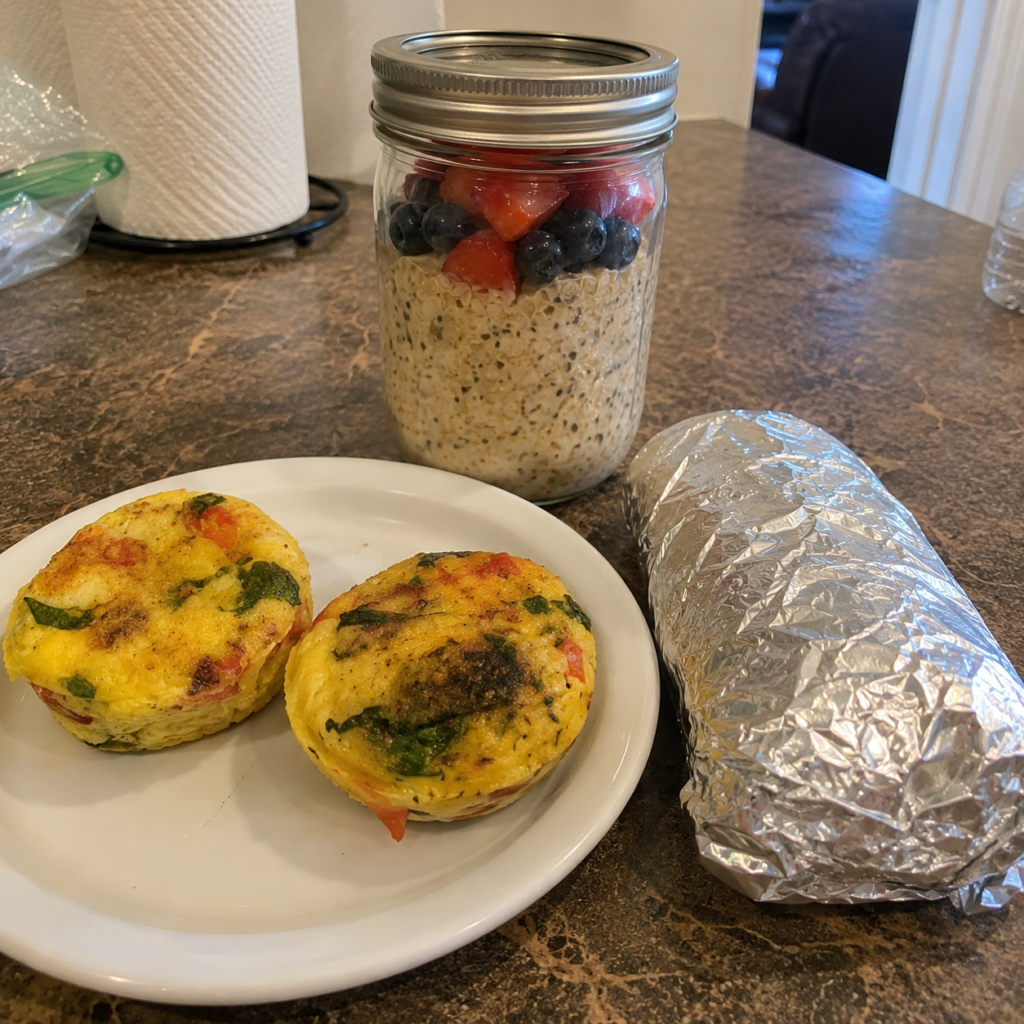
The fix isn’t a better recipe. It’s a different structure: one baked dish, one batch assembled cold, and one freezer backup — built the same Sunday, used across the week based on what each format can survive. Here’s how to build all three so they hold up through Friday.
At a Glance
| Time required | About 1 hour Sunday (20 minutes of that hands-off oven time), plus a 5-minute reset Wednesday |
| Difficulty | Easy — nothing harder than scrambling eggs and pouring a jar |
| Cost range | $35–55 one-time for containers; roughly $15–20 a week in ingredients for one person |
| What you’ll need | A 12-cup muffin tin, wide-mouth pint jars, a few glass storage containers, quart freezer bags |
| Who this is for | Anyone eating breakfast at home on weekdays who’s tired of one dish going stale by Thursday |
Why One Big Batch Runs Out of Steam by Wednesday
A single batch-cooked breakfast fails for two separate reasons, and most advice only deals with one of them.
The first is texture. Reheating isn’t neutral — every cycle through heat tightens egg proteins further and pushes out moisture, which is why a Monday egg muffin is soft and a Thursday one is closer to rubber. Starches behave the same way: baked oatmeal keeps losing moisture in the fridge, so oven-fluffy on Sunday reheats dense by midweek. Anything crisp — bacon, hash browns, granola — softens within hours in a covered container, since trapped steam has nowhere else to go.
The second is repetition. Eating the same exact meal five mornings running has a natural ceiling — not because the food gets worse, but because nothing about it changes. Three formats instead of one gets around both problems: each degrades on its own timeline, so there’s always one still at its best on a given morning.
The Gear That Actually Earns Its Space
Four things make this work. Here’s what actually matters about each one.
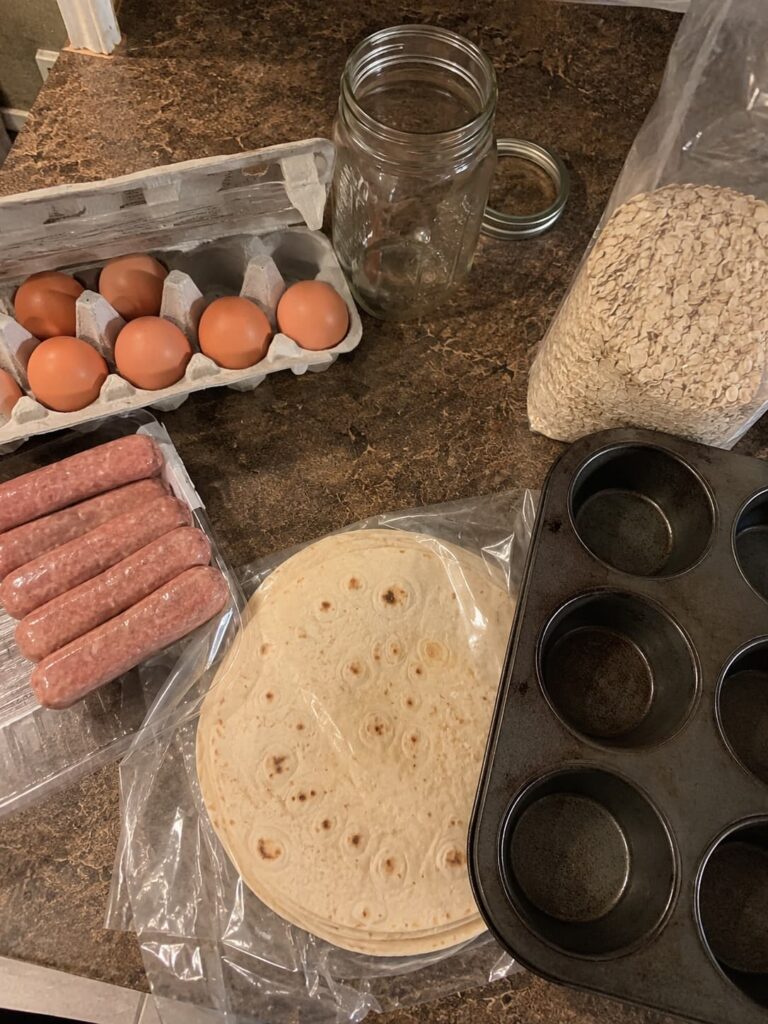
A 12-cup muffin tin, standard size, for the baked component — nonstick, or a regular one greased well, so muffins don’t tear on the way out. $10–15 at any big-box store.
Five wide-mouth pint jars (16 oz) for the assembled component. Wide-mouth matters more than it sounds — a narrow jar makes it nearly impossible to reach the last bite of oats with a spoon. A dozen runs $10–14.
A few 3-cup glass containers with airtight lids, for anything that needs to sit in the fridge without picking up the smell of last night’s dinner. A five-pack runs $15–20.
A box of quart-size freezer bags for the format headed to the freezer — $4–5 for 25–40, and the one item here where store brand performs identically to name brand.
Skip for now: a dedicated egg-bite maker, a specialty smoothie-pack system, or any single-purpose gadget. Those earn their space once you know which format you’ll actually keep making — rarely obvious before week two.
The Three-Layer Sunday System
Together, these three stages make more than five days of breakfast, on purpose — the extra egg muffins and all six burritos carry into the following week, so Sunday’s hour buys more than seven days of mornings.
Stage 1 — The baked component (about 35 minutes, mostly hands-off)
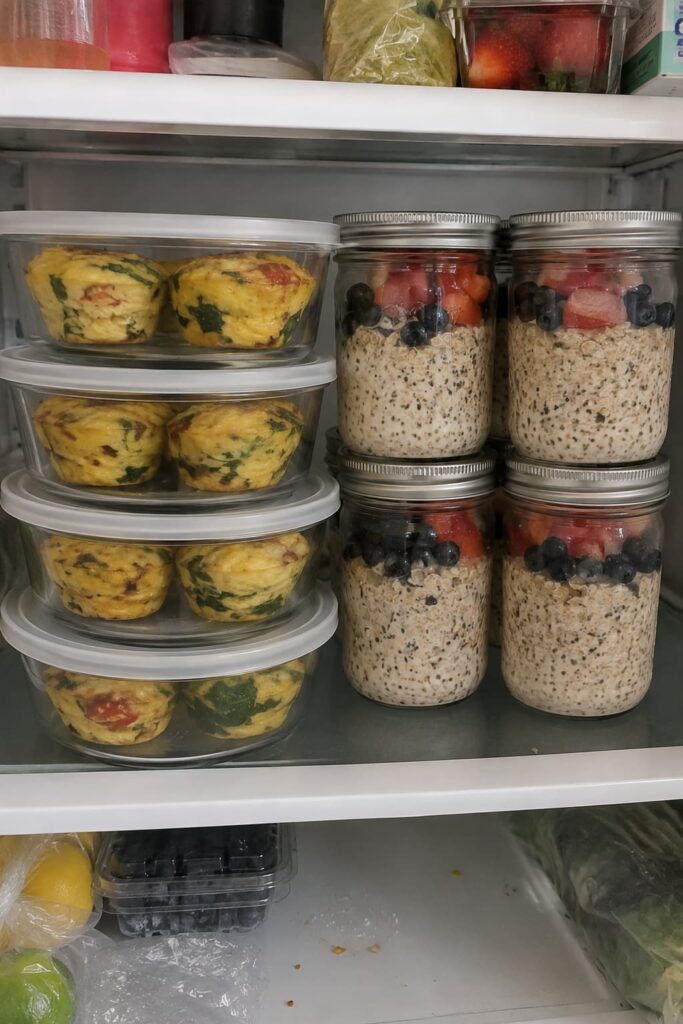
Whisk a dozen eggs with ¼ cup milk and about 1 cup total of mix-ins — chopped vegetables, cooked meat, or shredded cheese all work without overfilling the cups. Grease a 12-cup muffin tin well, since egg sticks to bare metal even in a decent pan. Divide the mixture evenly and bake at 350°F for 20 to 22 minutes, until the centers are set and don’t jiggle when the pan is nudged; an instant-read thermometer should read 160°F at the center of the largest muffin. Let them sit in the tin for 5 minutes before removing, or they’ll tear.
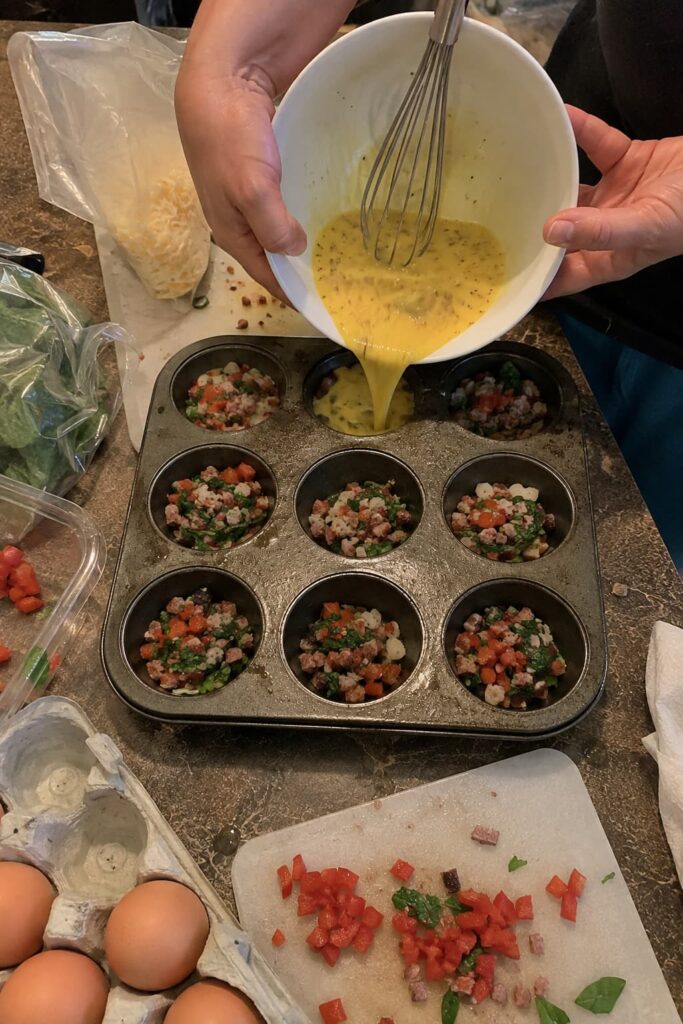
The mistake here is pulling them because the tops look set. Egg dishes finish from the outside in, and a center that’s still glossy at 18 minutes needs the full 20 to 22 — an early pull means a soft middle that turns watery by day two.
Stage 2 — The assembled component (10 minutes, no cooking)
While the eggs bake, layer three pint jars with ½ cup rolled oats, ½ cup milk, ¼ cup plain or vanilla yogurt, and 1 tablespoon chia seeds each. Stir once to break up clumps and refrigerate. This ratio — equal parts oats and milk, plus yogurt for creaminess and chia for hold — is what keeps the texture spoonable instead of chalky.
Only make three jars on Sunday, not five. Dairy-based oats follow the same 3-to-4-day refrigerated window as any cooked leftover, so a jar made Sunday is at its edge by Wednesday. Make the remaining two jars Wednesday — five minutes, no real planning — so every jar you eat is inside its freshness window instead of one batch stretched across five days.
Stage 3 — The freezer component (about 20 minutes)
Scramble 6 eggs, cook and crumble 8 ounces of breakfast sausage until no longer pink (or substitute a drained 15-ounce can of black beans), and shred 1 cup of cheese. Warm six 10-inch tortillas just enough to fold without cracking — about 10 seconds each in a dry skillet — then divide the filling evenly and roll into burritos. Wrap each one individually in foil or parchment, then group them in a labeled, dated freezer bag.
The mistake here is skipping the individual wrap and tossing burritos straight into one bag — air gets between them and the tortilla dries into a cracked, papery texture. Wrapped well, these hold their texture for about 3 months in the freezer; the eggs and cheese stay safe well beyond that, but the tortilla degrades first.
Where This Breaks Down Between Monday and Friday
The eggs turn rubbery by Thursday. This is protein chemistry, not spoilage — every reheat tightens egg proteins a little further. Reheat gently: 45 seconds at 50% microwave power gets a cold muffin hot without cooking it a second time. Full power for 90 seconds is what makes it bouncy.
The oats separate or turn watery. Chia and oats settle over a few days, leaving a thin layer of liquid on top — stir it back in and it’s fine. If it’s gone watery rather than separated, that’s the texture edge: eat it today or not at all.
Fruit on top turns to mush. Cut fruit sitting directly on yogurt breaks down within a day or two as its moisture bleeds into the jar. Keep fruit in a separate small container and add it the morning you eat, not at assembly.
The fridge starts to smell like eggs. Egg dishes absorb and give off odors easily, especially in a container that isn’t fully sealed. A snap-lid glass container solves this; a bowl with plastic wrap over it doesn’t.
Freezer burn shows up on the burritos by week three. This happens when the wrap wasn’t tight enough or air got into the bag. Press the air out by hand before sealing, or draw it out through a small gap with a straw first.
Something gets eaten on day five that shouldn’t be. The 3-to-4-day window applies to the egg muffins and the oats in practice, not just on paper. If Sunday’s batch is still around by Friday, it goes in the trash, not the toaster — the one rule here that isn’t flexible.
Scaling It Up, Down, or Around a Smaller Kitchen
No muffin tin, or nowhere to store one: Pour the same egg mixture into a greased 8×8 dish and bake at 350°F for 28 to 32 minutes, until the center hits 160°F. Cut into squares instead of popping out muffins.
Cooking for a household of four: Double Stages 1 and 2, but change the vessel, not just the amount — two dozen eggs in a 9×13 pan instead of a muffin tin, baked at 350°F for 30 to 35 minutes since the extra depth takes longer to set. Double the oat jars and the burrito batch too.
Tight grocery budget: Skip Stage 3. Sausage, cheese, and tortillas are the priciest part of this system per serving; eggs and oats alone keep a full week of breakfast for one person under $15.
Dairy-free or gluten-free: Swap the milk in the eggs and the oats for unsweetened oat or almond milk — no ratio change needed. For gluten-free, use oats labeled gluten-free specifically, since regular oats are often cross-contaminated with wheat, and swap in corn tortillas for Stage 3.
A rental with a small freezer: Cut Stage 3 and lean on Stage 2 instead, making a fresh 3-jar batch twice a week — more frequent effort, but far less freezer space than a stack of burritos.
What Everyone Asks Before They Start This
Can I meal prep breakfast for two weeks at once? Not in the fridge — the 3-to-4-day window doesn’t stretch no matter how airtight the container is. The freezer burritos are built for longer storage, up to about 3 months.
Is it safe to eat egg muffins that have been in the fridge for five days? No. USDA guidance puts cooked egg dishes at 3 to 4 days refrigerated, the same as any other cooked leftover. Past that, it’s not worth the risk.
Can I freeze overnight oats instead of making a fresh batch midweek? Technically, but the texture turns grainy and separates on thaw, since oats and chia absorb liquid differently once frozen. A fresh five-minute batch on Wednesday works better than a freezer jar here.
Why do my egg muffins deflate after they cool? That’s normal — they puff up from trapped steam in the oven, then settle as they cool. It doesn’t affect the texture once reheated.
What’s the cheapest version of this system? Eggs and oats only, skipping the burritos. Both are inexpensive at any grocery store, keeping a full week of breakfast for one person under $15.
Can smoothies be part of this system? Freeze the fruit and vegetable portions flat in bags, not the finished smoothie, which separates and turns watery in the freezer. Blend fresh with milk or yogurt the morning of.
Do the burritos need to be thawed before reheating? No. Microwave from frozen, wrapped in a damp paper towel, for 2 to 3 minutes, flipping halfway. Or bake wrapped in foil at 375°F for 25 to 30 minutes if the microwave leaves the tortilla tough.
One Layer at a Time
Start with just Stage 1 the first week — one dozen eggs, one muffin tin, twenty minutes in the oven. That alone solves most of the Monday-morning scramble without a full system overnight. Add the oat jars once the egg muffins feel automatic, and treat the freezer burritos as the last piece, built once breakfast meal prep has already proven it’s going to stick. The goal isn’t cooking more on Sunday. It’s spending the same hour differently, so what’s in the fridge Thursday still tastes like something you’d choose.
