
How to Organize a Corner Cabinet with a Lazy Susan
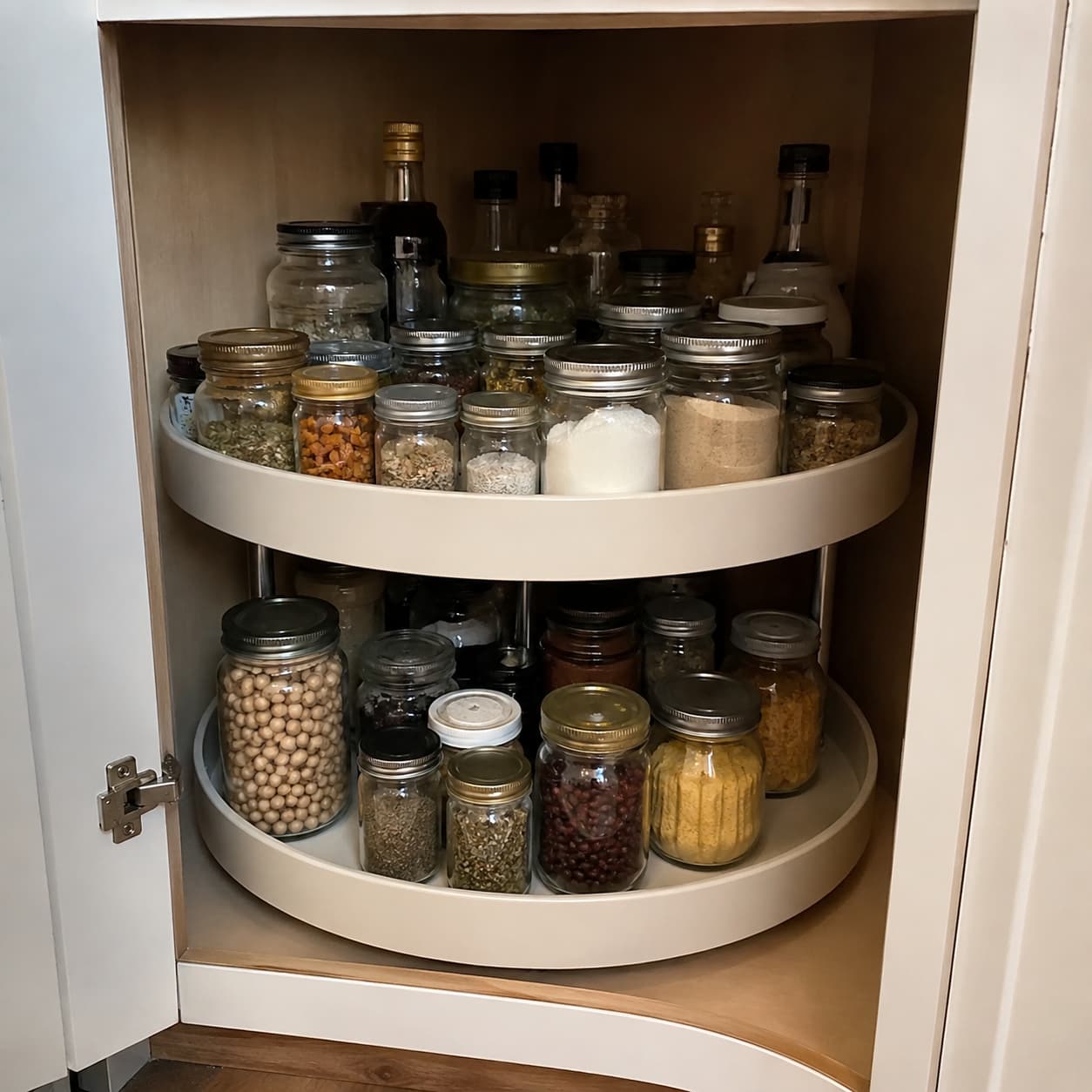
A corner cabinet looks like extra storage on paper and behaves like a black hole in practice. The door opens onto a curved or angled space where the back half disappears around a corner your arm physically can’t follow, and whatever gets pushed back there — the extra crockpot, the roasting pan used twice a year — stays lost until the next time everything gets pulled out for a deep clean. A lazy Susan doesn’t add space to that cabinet. It just makes the space that’s already there reachable, by turning “reach around a blind corner” into “spin and pull,” which is the entire difference between storage that gets used and storage that gets forgotten.
Quick Overview
| Time required | 30–45 minutes |
| Difficulty | Easy |
| Cost range | $15–$45 for the turntable itself |
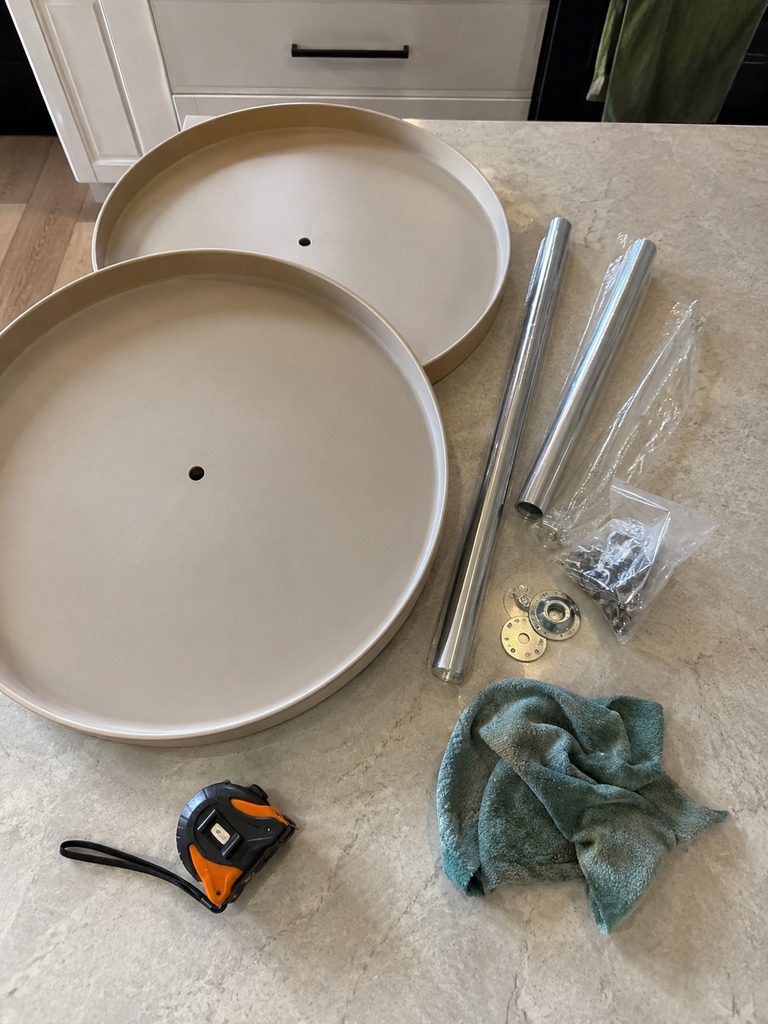
| What you’ll need | Tape measure, a two-tier turntable sized to the cabinet, a damp cloth |
| Who this is for | Anyone with a corner base cabinet where items regularly disappear toward the back |
Why the Back of a Corner Cabinet Disappears
A standard corner base cabinet runs roughly 33 to 36 inches along each wall, with the usable interior curving or angling back well past the 12 to 14 inches a hand can comfortably reach and see into. That geometry is exactly what a straight cabinet doesn’t have — a 24-inch-deep base cabinet is a rectangle you can see the back of by leaning in slightly, while a corner cabinet’s far reaches sit behind the door frame itself, invisible from the doorway no matter how far you lean.
A turntable solves this by removing the need to reach into that blind zone at all. Instead of a hand searching blind past 14 inches of depth, the whole platform rotates the contents to the front. Nothing about the cabinet’s shape changes — the fix is entirely about motion replacing reach, which is why a $20 turntable does more for a corner cabinet than any bin or organizer built for a straight-walled space.
What to Measure Before Buying Anything
Corner cabinets vary more than any other cabinet type in a kitchen, which makes the shopping list short but the measuring step non-negotiable.
- Opening width, inside edge to inside edge of the door frame. Most turntables are sold by diameter — 18, 20, 24, 28, or 32 inches — and a size that doesn’t clear the door frame won’t rotate freely once it’s loaded.
- Interior height, floor to the underside of the fixed shelf, if there is one. This determines whether a two-tier turntable fits as a single unit or whether the cabinet needs two smaller single turntables stacked at different heights instead.
- Full 360-degree door swing. A corner cabinet with a bifold or lazy-Susan-style door built into the cabinet itself needs a turntable designed for that mechanism specifically — a standard freestanding turntable can jam against a door that swings differently than expected.
Write these three numbers down before shopping. A turntable bought by guessing at “corner cabinet size” is the most common return in this category.
Installing and Loading the Turntable
Step 1 — Empty and clean the cabinet (10 minutes). Pull everything out, including anything wedged into the true back corner that hasn’t seen daylight in months. Wipe down the shelves — corner cabinets collect more dust and crumbs than straight ones simply because they get cleaned less often, precisely because reaching in is awkward.
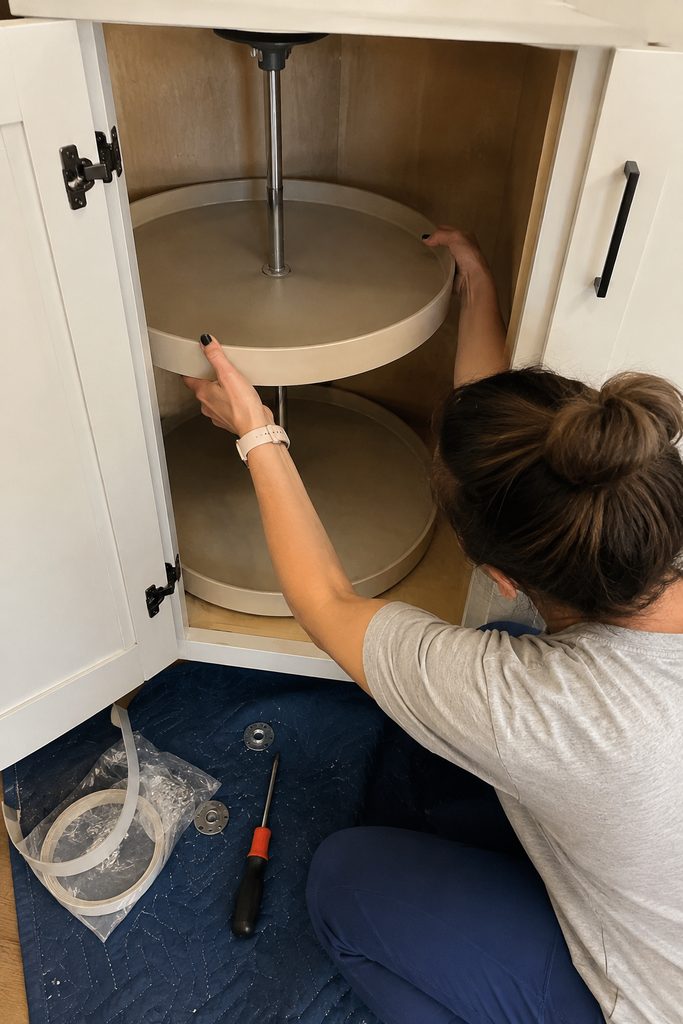
Step 2 — Measure twice, then place the turntable (5 minutes). Center the turntable on the shelf and give it a full spin before loading anything, checking that it clears the door frame and any interior cabinet lip through the entire rotation. A turntable that catches on one specific point will keep catching there once it’s loaded, so this is worth confirming empty.
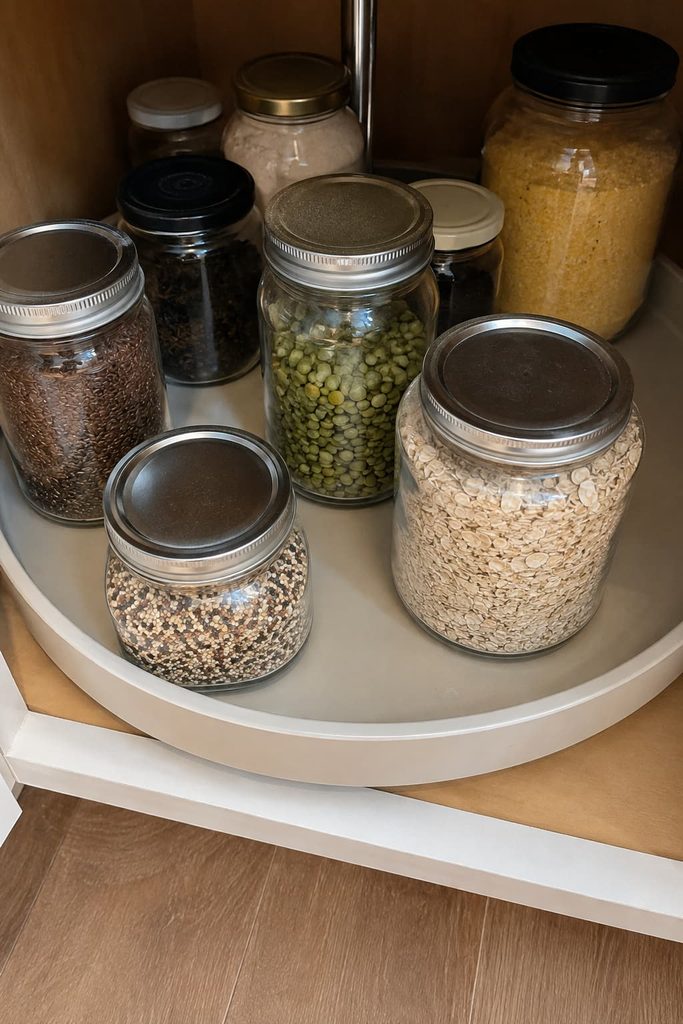
Step 3 — Load by weight and frequency, not by category (10 minutes). Heavier items go toward the center of the turntable, near the pivot point, where the rotation carries less leverage and less risk of tipping. Lighter, more frequently used items go toward the outer edge, where a partial turn brings them within reach fastest. Done right, nothing on the turntable is taller than the cabinet’s interior height at any point in its rotation — a bottle that clears the shelf above only when the turntable sits at one specific angle will jam the whole system.
Step 4 — Leave gaps between items (5 minutes). A turntable packed edge to edge doesn’t actually solve the corner cabinet problem — it just moves the same blind, hard-to-reach clutter onto a rotating platform. Leaving visible gaps between items is what lets a full spin actually reveal everything instead of hiding half of it behind the item in front.
What Breaks the System After a Few Months
The turntable stops spinning smoothly. Almost always overloaded past its weight rating, or something taller than the interior clearance is catching at one point in the rotation. Fix: pull the heaviest single item off and check whether the spin frees up — that’s usually the culprit.
Items still end up pushed to the back edge instead of staying accessible. Loaded too tightly, with no gaps to spin through. Fix: remove roughly 20 percent of what’s on the turntable and store it elsewhere — a corner cabinet turntable works best around three-quarters full, not packed solid.
Bottles or jars tip over during rotation. They were placed near the outer edge, where a spin carries the most lateral force. Fix: move anything tall and top-heavy toward the center, and keep the outer ring for wider, more stable items.
Crumbs and spills build up faster than expected. A rotating surface actually collects debris differently than a fixed shelf — spills spread across more of the surface as the platform turns. Fix: wipe the turntable down monthly rather than waiting for the full cabinet reset.
New items get set on top of the turntable instead of on it properly. Someone drops a bag of something on top of an already-loaded tier because it’s the closest flat surface. Fix: keep a small gap reserved specifically for new or overflow items so there’s always an obvious spot, rather than a stack forming on top of everything else.
Fitting a Turntable to a Different Cabinet
A shallow corner cabinet. A single-tier turntable, rather than a two-tier, avoids wasting height in a cabinet where the interior clearance is already tight — check the measurement from Step 2 above before assuming two tiers will fit.
A cabinet with a built-in bifold lazy Susan door. Skip a standalone turntable entirely and check that the built-in mechanism still swings freely — these sometimes need their own hardware adjustment rather than an added product.
Renters. A freestanding turntable needs no installation at all — it sits on the existing shelf and lifts out cleanly at move-out, unlike a pull-out shelf system that requires drilling.
A cabinet holding small appliances instead of food. Weight matters more here — most turntables are rated for a specific maximum load, and a stand mixer or slow cooker may exceed it. Check the weight rating specifically before loading anything heavier than typical pantry items.
A double corner setup, with cabinets on two adjoining walls. Treat each cabinet as its own measuring and loading project — a turntable sized for one corner rarely fits the other cleanly, even when the cabinets look similar from the kitchen.
Corner Cabinet Questions, Answered
What size turntable fits a standard corner cabinet?
Most corner base cabinets take an 18- to 24-inch turntable, though the only reliable way to know is measuring the door opening and interior clearance directly, since corner cabinet dimensions vary more than straight ones.
Is a two-tier turntable better than a single tier?
It depends on interior height. Two tiers make better use of a tall cabinet, but only if there’s enough clearance between the tiers for the items actually being stored — a tier gap too short for a typical bottle defeats the purpose.
Do I need to buy a specific brand, or does any turntable work?
Function matters more than brand here. A generic turntable at the right diameter and weight rating performs the same job as a premium one — the measuring step determines success far more than the product choice.
What’s the weight limit on a typical lazy Susan?
Most home turntables are rated for roughly 20 to 40 pounds total, spread across the surface. Concentrated weight in one spot, like a single heavy stand mixer, stresses the bearing more than the same weight distributed across several items.
Can a lazy Susan go in a cabinet that isn’t in a corner?
Yes, though it’s most useful specifically where blind, hard-to-reach space exists — a deep cabinet or a cabinet with an awkward door swing benefits from the same rotating-access logic even outside a true corner.
How often does a corner cabinet turntable need to be reorganized?
About every three to four months for most households, or any time the spin stops feeling smooth — that resistance is usually the first sign something’s overloaded or misplaced before it becomes a bigger problem.
The Corner Was Never the Problem
A corner cabinet doesn’t need less stuff in it or a smarter category system — it needs a way to bring the far side of the space to the front, since no amount of organizing changes the geometry of a blind curve behind a door frame. A turntable sized correctly to the cabinet and loaded with gaps left on purpose does exactly that, turning a spot that used to swallow whatever went in it into one of the more usable cabinets in the kitchen. Measure first, buy second, and the corner stops being the cabinet nobody wants to open.
