
Cottage Cheese Egg Bites for Meal Prep

The Starbucks version of these costs about $5 for two, gets made in a sous vide machine that holds water at a precise temperature for close to an hour, and has become popular enough that entire forums exist just to reverse-engineer it. Most home versions skip the sous vide equipment and go straight into a muffin tin in the oven — reasonable, since almost nobody owns a sous vide setup for breakfast — but they also skip the one ingredient doing the real work in the original: cottage cheese, blended smooth into the eggs rather than left in curds. That’s what gives the Starbucks version its dense, custardy texture instead of the drier, more rubbery result a plain egg muffin usually turns into after a few days in the fridge.
Blended cottage cheese does two things a straight egg mixture can’t. It adds moisture that survives reheating instead of cooking out, and its protein structure sets into something closer to a custard than a scrambled egg. The oven version here isn’t identical to a sous vide machine’s output — a water bath in the oven gets close, not exact — but it’s close enough that the texture holds up through four days of reheats, which the coffee-shop version was never actually built to do in the first place. This makes 12 bites, portions into 4 servings, and takes about 45 minutes total, most of it hands-off in the oven.
Quick Facts
| Prep Time | 15 minutes |
| Cook Time | 30 minutes |
| Total Time | 45 minutes |
| Servings | 4 (3 bites each) |
| Difficulty | Easy |
| Storage Life | 4 days refrigerated; up to 3 months frozen |
What a Blender Replicates, and What It Doesn’t
Sous vide cooking holds food at a low, exact temperature in a sealed bag submerged in water, which is why the coffee-shop version sets into something closer to a savory custard than scrambled eggs — the proteins coagulate slowly and evenly, with no direct contact with a hot pan or oven rack. A home oven can’t hold water-bath precision the same way a sous vide circulator does, but a water bath — the muffin tin set inside a larger pan with hot water reaching partway up the sides — gets close by insulating the eggs from the oven’s more aggressive direct heat.
The blended cottage cheese matters just as much as the water bath. Cottage cheese is mostly curds of casein protein suspended in whey, and left whole, those curds show up as visible white lumps in a baked egg dish — not unpleasant, just clearly not what the coffee shop is selling. Blended smooth with the eggs before baking, that same protein and moisture disperses evenly through the mixture, which is what gives the finished bite its dense, slightly wobbly texture instead of the springier, drier result a straight egg-and-milk muffin produces.
Ingredients
- 6 large eggs
- ¾ cup full-fat cottage cheese (low-fat works, but the finished texture is noticeably less rich and slightly more watery)
- ¼ tsp kosher salt
- ⅛ tsp black pepper
- ½ cup shredded Monterey Jack or cheddar
- ½ cup diced cooked bacon or ham (about 4 slices bacon, cooked and chopped)
- ½ cup chopped fresh spinach
- ¼ cup finely diced red bell pepper

What You’ll Cook This In
- A blender or food processor — this is the step that actually makes the texture, not an optional shortcut
- A standard 12-cup muffin tin
- A roasting pan or larger baking dish the muffin tin fits inside, for the water bath
- Nonstick spray or a light coating of oil for each muffin cup, since eggs stick aggressively to bare metal
- An instant-read thermometer — eggs are safe at 160°F, and the water bath makes visual doneness cues less obvious than a dry-baked egg dish
The Water Bath, Explained Before It’s Needed
A water bath sounds like an extra step worth skipping, but it’s the difference between an evenly set custard and a dish that’s rubbery at the edges before the center’s even cooked. Direct oven heat hits the outer ring of each muffin cup first, and without water insulating the pan, that outer ring overcooks by the time the center catches up. Hot water added around the muffin tin slows and evens out that heat transfer, so the whole bite finishes at closer to the same rate.
From Blender to Muffin Tin
Preheat and prep the water bath — 5 minutes. Preheat the oven to 325°F. Bring a kettle or a pot of water to a near-boil, and grease all 12 cups of the muffin tin thoroughly — this matters more here than in a standard muffin recipe, since a blended egg mixture has no flour to help it release cleanly.
Blend the base — 2 minutes. Combine the eggs, cottage cheese, salt, and pepper in a blender and blend until completely smooth, with no visible curds remaining, about 30 to 45 seconds on medium-high.
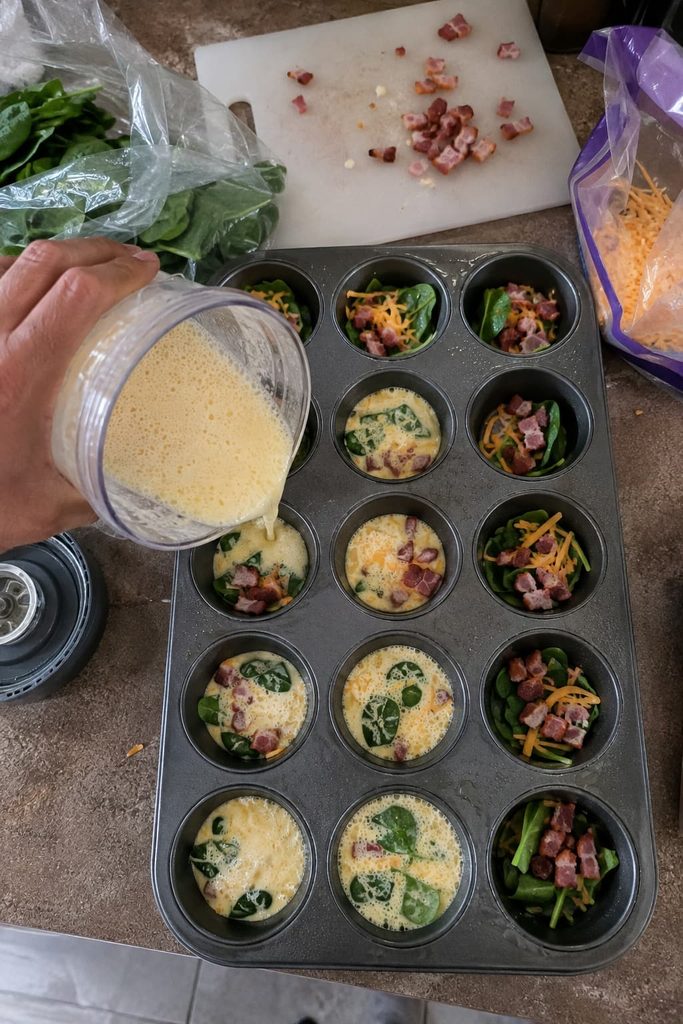
Fill the tin and add the mix-ins — 5 minutes. Divide the bacon or ham, spinach, bell pepper, and shredded cheese evenly among the 12 cups first, then pour the blended egg mixture over each, filling to about ¾ full — they’ll puff slightly in the oven and settle back down as they cool.
Set up the water bath and bake — 25 to 30 minutes. Place the filled muffin tin inside the larger roasting pan on the oven rack, then carefully pour the hot water into the roasting pan until it reaches about halfway up the sides of the muffin tin, avoiding splashing any into the egg cups themselves. Bake 25 to 30 minutes, until the centers are set with a slight jiggle (not liquid) and a thermometer inserted into the middle bite reads 160°F.
Cool before removing — 10 minutes. Let the tin cool in the water bath for a few minutes, then transfer it to a rack. Run a thin knife or offset spatula around each cup before lifting the bites out — they’ll release far more easily warm than after they’ve fully cooled and the egg has firmed up against the tin.

Storing and Reheating Without Losing the Texture
Cool completely to room temperature before sealing, no more than 2 hours after baking, per USDA guidance for cooked egg dishes. These keep 4 days refrigerated in an airtight container, with a paper towel underneath to absorb any condensation that would otherwise soften the bottoms.
For longer storage, freeze in a single layer on a sheet pan until solid, about 2 hours, then transfer to a freezer bag — this keeps them from fusing into one block. Frozen egg bites hold their texture well for up to 3 months.
Reheat from the fridge, in the microwave. 30 to 45 seconds at 50% power for two bites, checking and adding time in 10-second bursts — full power tends to make the edges rubbery before the center’s fully warmed.
Reheat from frozen. Microwave at 50% power for 60 to 75 seconds, or let them thaw in the fridge overnight and reheat at the shorter fresh-from-the-fridge time above.
Where the Coffee-Shop Texture Falls Apart at Home
The bites turn rubbery by day three. Almost always a full-power microwave reheat — egg proteins that are already fully set tighten up fast under high, direct heat. Fix: reduce the power and reheat in shorter bursts, checking in between.
Visible curds show up despite blending. The blend time was too short, or the cottage cheese was very cold and didn’t break down fully. Fix: blend a full 45 seconds to a minute, and let refrigerated cottage cheese sit at room temperature for a few minutes first if it’s very cold.
The bites won’t release from the tin cleanly. Either the tin wasn’t greased thoroughly enough, or they cooled fully before being removed. Fix: grease every cup individually, including the walls, not just the bottom, and un-mold them within about 10 minutes of coming out of the oven.
The centers stayed underdone while the edges overcooked. The water level in the bath was too low, or the water wasn’t hot when it went in. Fix: use water that’s already near-boiling, and bring it up to roughly the halfway mark on the muffin tin, not just an inch or two.
Watery liquid pools at the bottom of the container after a day or two. Some liquid release is normal with cottage cheese, even blended smooth — it’s releasing whey slowly over time. Fix: line the storage container with a paper towel, which absorbs the moisture without affecting the bites themselves.
Changing the Mix-Ins Without Changing the Method
Vegetarian: Skip the bacon or ham and add an extra ¼ cup of bell pepper along with ¼ cup of diced mushrooms, sautéed briefly first to cook off their moisture before they go into the tin.
Lower-carb, higher protein: Add an extra ¼ cup of shredded cheese and skip the bell pepper — this pushes the protein-to-carb ratio further without changing the core method at all.
Southwest style: Swap the bacon for cooked, crumbled chorizo, and add 2 tablespoons of diced green chiles along with a pinch of cumin to the egg mixture before blending.
Dairy-free: This one’s genuinely difficult to replicate — cottage cheese is doing structural work here, not just flavor, and most dairy-free substitutes don’t have the same protein behavior. A straight egg-and-water-bath method without any substitute gets a lighter, less custardy result, which is a different dish rather than a true swap.
Cottage Cheese Egg Bite Questions, Answered
Do I actually need a water bath, or can I just bake them like regular muffins?
The water bath is what gets closest to the coffee-shop texture. Skipping it produces a drier, more evenly rubbery result, closer to a standard baked egg muffin than a custardy bite — still edible, just a different dish.
Why cottage cheese instead of milk or cream, which most egg bite recipes use?
Cottage cheese brings both moisture and protein structure that milk doesn’t. A milk-based version tends to weep more liquid on reheat and doesn’t hold the dense, custardy texture nearly as long over several days of storage.
Is it safe to eat these if the center still looks slightly jiggly after baking?
A slight jiggle is normal and expected — that’s the custard texture, not underdone egg. What matters is the internal temperature, which should read 160°F at the center bite, regardless of how it looks.
How long do these actually last in the fridge?
Four days, refrigerated at or below 40°F, as long as they were cooled and sealed within 2 hours of baking, per USDA guidance for cooked egg dishes.
Can I make these in a smaller sous-vide-style silicone mold instead of a muffin tin?
Yes, and it gets closer to the Starbucks size and shape specifically. The bake time may need to shift down slightly since silicone molds are usually a bit smaller than standard muffin cups — start checking at 20 minutes.
Why did my cottage cheese curds not fully disappear even after blending?
Some brands of cottage cheese use a firmer curd that takes longer to break down. If a full minute of blending on high still leaves visible flecks, straining the blended mixture through a fine-mesh sieve removes what’s left.
Can these be made ahead for a whole two weeks instead of freezing?
No — refrigerated egg dishes are only good for 4 days per USDA guidance regardless of how they’re prepared. For longer storage, freeze the extra batch instead of extending the fridge window.
Twelve Bites, One Blender, No Sous Vide Machine
The version that costs $5 for two at a coffee counter and the version made at home in a muffin tin aren’t identical, and treating them as the same recipe with a different pan is usually where home versions fall short. Blending the cottage cheese in with the eggs, and giving the tin a proper water bath instead of dry oven heat, closes most of that gap without needing any equipment beyond a blender that’s probably already in the kitchen. What’s left after that is genuinely just a batch of 12 bites that hold their texture through the week — worth more than the $5, four days running.
